
The salderingsregeling is ending.
From 1 January 2027, the way Dutch households benefit from solar energy will change. If you already have solar panels, understanding when you generate, store and use your energy becomes increasingly important.
What Dutch Homeowners Need to Know
From 1 January 2027, the way Dutch households benefit from solar energy will change. This guide explains what the salderingsregeling is, what’s changing, and how you can continue to get the most from your solar investment.
Your Questions, Answered
-
The salderingsregeling (net metering scheme) allows you to offset electricity you feed back into the grid against the electricity you use from the grid. This means the electricity you export in sunny periods effectively reduces your bill later in the year.
It was introduced to stimulate the adoption of solar panels in the Netherlands and has made solar a very attractive investment for many households.
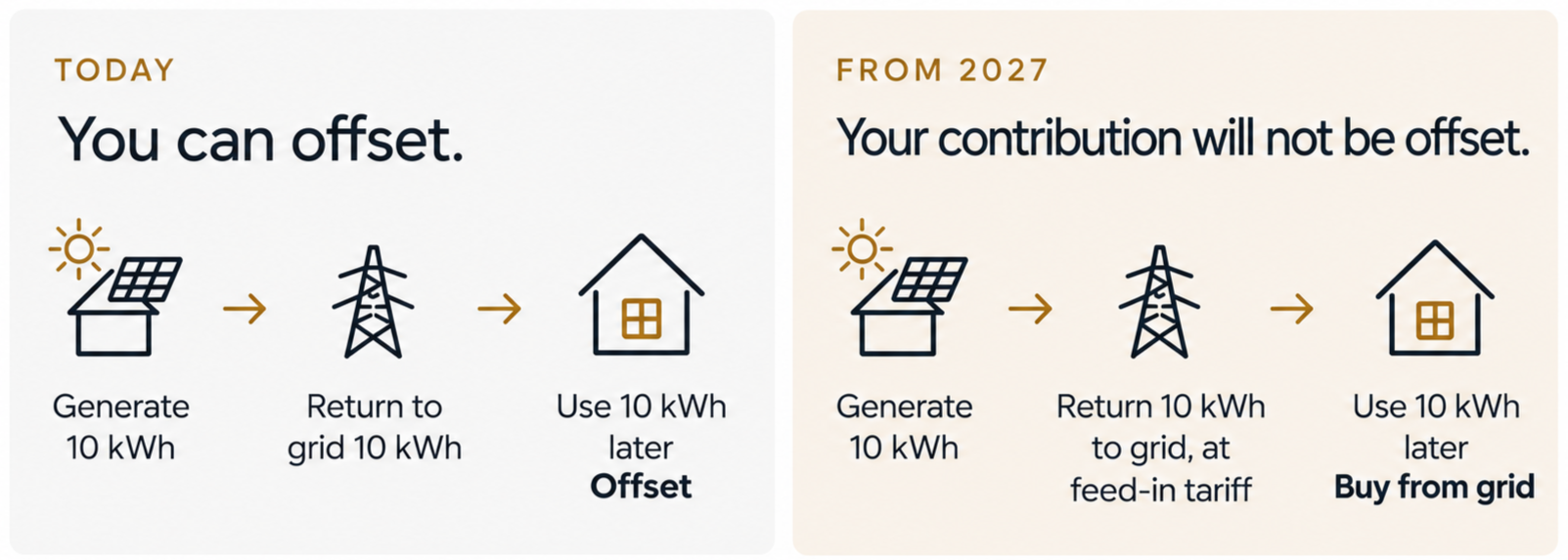
Before 1 January 2027, the electricity you return to the grid is valued at the same rate as the electricity you consume.
-
The salderingsregeling will end on 1 January 2027. From this date, you will no longer be able to offset the electricity you feed back to the grid against your own consumption.
Instead, you will receive a compensation payment for the electricity you export, set by your energy supplier. This payment is typically lower than the rate you pay for electricity, meaning it will be more valuable to use your own solar energy directly or store it for later use.
-
Your existing solar panels will continue to work and generate clean energy. The change doesn’t mean solar becomes a bad investment — it simply means the way you get the most value from your solar energy is different.
Instead of relying on the grid to balance your production and consumption over the year, there is greater value in using more of your own solar electricity when you generate it, storing surplus energy for later, and managing when you draw electricity from the grid.
-
From 1 January 2027, electricity you return to the grid will no longer offset electricity you use later. Instead, your energy supplier will pay you a feed-in tariff for the electricity you export.
Energy suppliers may also charge feed-in costs (terugleverkosten) associated with processing returned electricity. Depending on your supplier and energy contract, these costs can eliminate the financial value of exporting your surplus solar energy - or even cost you more than the energy is worth.
This makes using more of the electricity you generate within your own home increasingly valuable. Electricity you generate and use yourself is not subject to energy tax or supplier charges.
-
Yes, you can. Energy suppliers can charge feed-in costs (terugleverkosten) for electricity returned to the grid.
A feed-in cost (terugleverkosten) is a fee that an electricity supplier can charge a household for sending surplus solar electricity back to the grid.
It’s separate from the feed-in tariff (terugleververgoeding), which is the money the supplier pays you for the electricity you export.
So after 2027, you can potentially have both happening:
You export electricity → supplier pays you a feed-in tariff → supplier may charge you feed-in costs → your net return is the difference.
For example, if your exported electricity earns you €0.05/kWh but the effective feed-in costs associated with that export are €0.07/kWh, you've effectively lost €0.02/kWh by exporting it.
The exact charges and compensation depend on your energy supplier and contract.
-
Yes. Solar panels remain a smart investment, even after 2027. While payback periods may be longer, solar still helps you reduce your energy costs, increases your energy independence, and contributes to a more sustainable home.
Importantly, the supply and installation of solar panels on or near residential homes remains subject to 0% VAT in the Netherlands. Home batteries and other components are currently subject to 21% VAT.
-
With the salderingsregeling ending, using your solar energy at the right time becomes more important. An energy management system brings your solar panels, battery storage, dynamic energy prices and home energy use together into one intelligent system.
It automatically optimises when to use, store or buy electricity, helping you increase your self-consumption, reduce your reliance on the grid and get the maximum value from every kilowatt you generate.
-
Without intelligent energy management, your home can continue sending surplus solar energy to the grid when it would be more valuable to use or store it, only to buy electricity back later when your home needs it.
Core Automation changes this. Our Energy Management System continuously decides whether it is more advantageous to use, store, buy or export energy based on your solar production, battery capacity, household demand and electricity prices. This helps minimise unnecessary exports, maximise the value of your own solar energy and reduce the amount of electricity you need to buy back from the grid.
After 2027, it’s not just about generating energy. It’s about knowing how best to use it.

See what energy management could look like in your home.
No obligation. Designed around your home.